
ECS Exchange | January 2026
The Weight We're Carrying (And Why We Won't Put It Down)
A Letter from the ECS Team
We're not going to pretend this month didn't start off rocky.
While we originally planned to open this newsletter with new year’s goals and aspirations, survey insights and policy wins, it became clear in our team meetings—and in the dozens of texts, calls, and late-night emails many of you have sent—that what you need right now isn't a cheerful rundown of appropriations line items.
You need to know you're not alone in feeling the ground shift beneath you.
First, thank you to everyone who filled out our ECS 2025 Community Engagement Survey. We got a lot of feedback and helpful insight into the needs and wants of our community. We plan on doing this survey every year, so be on the lookout this winter 2026.
Seventy-two percent of you told us policy updates matter most. But here's what we heard between those lines: policy updates matter because the rules keep changing, and we're exhausted from building programs on sand.
So let's start there—with the truth of this moment, and then with the strategy to navigate it.
The Brutal Reality: When "Fraud" Becomes a Political Weapon
The federal administration's January push to freeze child care funds in five states (MN, NY, CA, IL, CO) isn't about fraud but another attempt to wield political power by using children as leverage.
If you're a provider in one of these states, you're facing impossible choices right now:
Do you keep staff on payroll when reimbursements might stop?
Do you turn away families who need care because you can't guarantee you'll be paid?
Do you close your doors and hope the courts move faster than your landlord?
A temporary block was secured on January 9th. But "temporary" is the operative word, and many of you have been in this field long enough to know that when the Child Care and Development Fund (CCDF) and Temporary Assistance for Needy Families (TANF) funds become political footballs, it's never the politicians who lose, it's the 3-year-old whose mom can't get to her second shift, and the provider who took out a loan to expand and now can't make payroll.
What This Means for Strategic Planning
Sixty percent of you identified securing funding as your top challenge. Here's the research-backed reality from our policy team:
Federal funding volatility is now a permanent variable in your business model. Think of it like building a house in earthquake country… you don't pray the ground stops shaking; you engineer the foundation to flex with it.
The days of multi-year federal stability are over, at least for the foreseeable future. But here's the thing about earthquakes: the structures that survive aren't the rigid ones. They're the ones built with multiple load-bearing points.
So what do we do?
1. Diversification isn't optional anymore.
If you're 80%+ reliant on CCDF, you're building on a single pillar. And when (not if) that pillar cracks, the whole structure comes down.
Look at Medicine Lodge, Kansas (population: 1,900), they built their "Plexes and Pods" model on blended funding:
CCDF for family subsidies
Local economic development grants (because childcare = workforce = business retention)
Private sector partnerships with downtown businesses (who need workers more than they need empty storefronts)
2. Document everything—but in the language that matters.
The Miami-Dade economic impact study showing $931.7M in annual economic losses from insufficient childcare? That's not just a number. That's your template.
Think of it as translation work. You already know childcare matters because of brain architecture and attachment theory. But your county commissioner doesn't speak that language. They speak:
Tax revenue lost when parents can't work
Business relocations when companies can't recruit talent
Emergency room costs when kids aren't getting preventive care
3. Build coalitions with non-traditional allies.
Workforce commissions, housing authorities, transportation departments, they all have budgets, and childcare is the infrastructure that makes their infrastructure work.
Texas's Workforce Commission monitoring "Defend the Spend" regulations isn't an accident; they understand that childcare is workforce infrastructure. Without it, their entire system collapses, job training programs, employer recruitment, economic development zones.
Think of yourself as the keystone in an arch. You're the small piece at the top that looks decorative, but pull it out and the whole structure falls. Your job is to make every other stakeholder understand that they need you to do their jobs.
Research Spotlight: What the Data Says About Survival
You told us you wanted more Research & Evaluation content (68%). Here's what recent studies reveal about programs that weather political storms:
From the National Women's Law Center's January 2026 brief:
Programs with 3+ funding streams were 74% more likely to maintain operations during funding freezes
Community-embedded programs (those serving as "third spaces" beyond childcare) saw 40% higher private/local funding resilience
Providers who publicly documented their economic impact secured emergency local funding 3x faster than those who didn't
What does this mean practically?
The future of sustainable Early Childhood Education (ECE) isn't just about being excellent educators, though you are. It's about being systems thinkers who can articulate value in multiple languages: developmental science for families, economic ROI for business leaders, workforce stability for policymakers, and community cohesion for local governments.
Here's the analogy that helped it click for our team: Think of your program like a tree in a forest.
The old model was a single tree in an open field. Beautiful, but vulnerable. One storm (funding cut), one disease (policy change), one lightning strike (political retribution) and it's over.
The new model is a grove. Your roots are intertwined with workforce development, with downtown revitalization, with public health initiatives, with employer retention strategies. When one tree gets hit, the others feed it through the root system until it recovers. You're not isolated, you're interconnected.
And here's the profound part: Once you see this, the strategy becomes obvious. You stop asking "How do I get more CCDF dollars?" and start asking:
"Who else benefits from my work existing?"
"What outcomes do they care about that I'm already producing?"
"How do I make myself essential to their success?"
You didn't sign up to be policy analysts and economists. We know. But the system has forced this evolution, and the good news is: you're already doing this work. Now we just need to make it visible.
More research to explore:
Innovation That Matters: Why "Third Spaces" Aren't Just Trendy
Medicine Lodge, Kansas gets a lot of attention for their "Plexes and Pods" model, but here's why it actually matters for the 36% of you navigating organizational capacity challenges:
The traditional model: Individual providers competing for the same families, duplicating overhead costs, isolated when crisis hits. It's like every household in a neighborhood digging their own well, building their own power plant, paving their own road.
The Third Space model: Multi-provider hubs that share:
Physical infrastructure costs (rent, utilities, outdoor space)
Administrative functions (billing, licensing compliance, HR)
Risk and resilience (if one provider's funding gets cut, the building doesn't go dark)
Political capital (harder to defund a downtown business anchor than a standalone center)
Think of it like this: When Jennifer Park calls this "the future of the sector," she means that siloed providers won't outlast this political climate. But networked, community-embedded, multi-stream-funded collaboratives might.
It's the difference between being a lone wolf and being a wolf pack. The lone wolf is more agile, but the pack survives the winter.
For your planning:
If you're an independent consultant or TA provider (24% of you), this is your opportunity. Communities need skilled facilitators to help providers navigate collaboration without losing autonomy. There's real work, and real funding, in being the bridge-builder.
You're the architect helping people design the grove, not the plantation.
Resources for collaborative models:
National Association for Family Child Care (NAFCC) Network Resources
Childcare Resource & Research Unit (Canada, but excellent frameworks)
The Appropriations Picture (Because Numbers Still Matter)
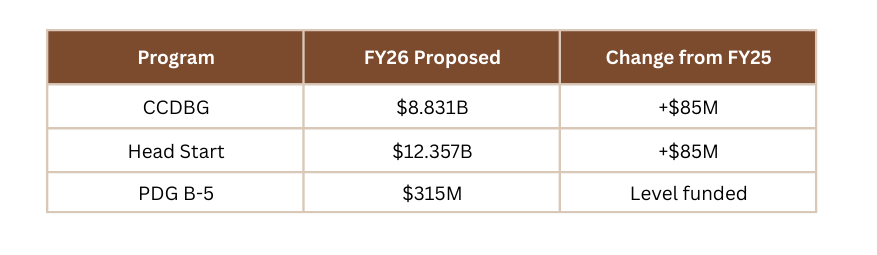
STATEMENT: FY2026 Funding Bill Boosts Federal Investment in Child Care and Early Learning
Here's the context those numbers need:
An $85M increase sounds meaningful until you remember that inflation alone eroded roughly $200M in purchasing power from last year's allocation. So in real terms, both CCDBG and Head Start are taking cuts while serving more children in higher-cost environments.
It's like getting a 2% raise when inflation is running at 5%. Technically your paycheck went up. Functionally, you're poorer.
And yet. These increases still happened in a political environment actively hostile to social programs. That tells us something important: the sector still has enough political muscle to move money, even in chaos.
The question is whether we can translate that into stable, long-term commitments or whether we're stuck in this exhausting cycle of annual cliff-edge negotiations.
Advocacy resources:
State Movements: The Divergence Accelerates
While federal funds freeze in some states, others are sprinting ahead:
New York: $4.5B investment toward universal childcare (Monroe, Dutchess, Broome pilots launching now)
Alabama: Governor Ivey backing screen time limits in licensed facilities for 0-5 year-olds
The gap: The difference between "best case" and "worst case" state support is now measured in billions of dollars
If you work across multiple states (as many consultants and universities do), you're essentially operating in different policy universes. Your New York strategy won't work in Texas. Your Alabama compliance framework is irrelevant in California.
The opportunity:
Cross-state learning networks are more valuable than ever. If you're in a state doing something innovative, you have knowledge that's worth real money to colleagues in states starting from scratch.
The Through-Line: How It All Connects
Here's what we want you to see, because once you see it, the path forward becomes clearer:
Every section of this newsletter is describing the same transformation:
Funding diversification = Building interconnected root systems instead of standing alone
Research translation = Speaking multiple languages to multiple stakeholders
Third Space models = Creating shared infrastructure that distributes risk
Appropriations strategy = Understanding you're in a political ecosystem, not just an educational one
State divergence = Recognizing you need to be fluent in multiple policy environments
It's all the same strategic shift: from isolated to interconnected, from monolingual to multilingual, from vulnerable to resilient.
The question isn't "Which of these strategies should I try?" The question is: "How do I become the kind of organization that can navigate complexity instead of hoping for simplicity?"
Because simplicity isn't coming back. The federal funding will keep being volatile. The state policies will keep diverging. The political environment will keep being hostile.
But complex ecosystems are more resilient than simple ones. A monoculture farm dies from one disease. A biodiverse forest adapts.
You're building the forest.
What ECS Is Building With You
This is hard work you're doing. You're trying to keep and support programs open while funding disappears. You're explaining to families why their subsidy got cut. You're writing grants at 11pm because the deadline won't move and the need won't wait.
We can't fix the political chaos (though we absolutely need to ramp up advocacy for midterms—register voters, support ECE champions, tell your stories to elected officials).
But we can build the infrastructure that helps you weather it:
Intelligence networks that move faster than policy changes
Peer support that doesn't require you to pretend you're fine
Research translation that turns data into political leverage
Coalition templates that work in your specific context
Cross-state learning exchanges that help you see what's working elsewhere
Funding diversification playbooks from people who've actually done it
One More Thing
While writing this newsletter, our Florida team member was enjoying 80°F weather while DC was buried in snow. Sixty-degree difference.
It felt like a metaphor for where the sector is right now, experiencing completely different realities depending on where you're standing.
But here's what we know: Whether you're in a state expanding access or fighting fund freezes, whether you're in a sunbelt state or snowed in, you're all trying to make sure children have what they need to thrive.
That's the through-line. That's the root system that connects the grove. That's what won't change no matter how chaotic policy gets.
We're in this with you.
—The ECS Team 🤎🤎
P.S. - Henderson, NV broke ground on a $17.6M preschool center on January 26th. In the middle of everything else, someone still believed enough in the future to build.
We're holding onto that.
