ECS Exchange | August 2026
How Head Start Affects Everyone
Opening Note
If your inbox and social feeds look anything like ours, you have probably been asked to sign, call, comment, share, or show up for something urgent at least once a week lately. In the last year you've been asked to care urgently about immigration enforcement, health coverage, student debt, food assistance, and roughly eleven other things… It can be hard to know what deserves your attention—especially when an issue does not seem to touch your family, your workplace, or your immediate community. Head Start may feel like one of those issues. Maybe you do not have young children. Maybe your children are grown. Maybe your family never qualified for the program. Maybe you are simply carrying enough already. That is understandable. And it is also why this particular moment is worth slowing down for.
Head Start is often described as a preschool program for children from families with low incomes. It is that. But it is also much more: it is child care that allows parents to work, have a local employer, have a health and developmental-screening connection, have a family-support system, have a stabilizing presence for children experiencing homelessness or foster care, and an early investment that can shape what schools, employers, health systems, and communities carry later.
In other words: even if no one in your household has ever enrolled in Head Start, you likely live in a community shaped by it.
The Department of Health and Human Services has proposed a significant rewrite of the Head Start Program Performance Standards. The proposal is open for public comment through October 6, 2026. It is not final, and programs should not change their operations based on it today. But it is a meaningful opportunity for families, practitioners, advocates, business leaders, educators, and community members to help shape the public record.
This edition breaks down what is changing, why the proposed changes matter beyond Head Start classrooms, and how to offer a useful public comment—without becoming a federal-policy expert first.
Policy & Funding Updates
Reducing Federal Burden for Head Start Programs | Proposed Rule
Comment deadline: October 6, 2026 Docket ACF-2026-0595 | RIN 0970-AD30
What it is. On August 7, HHS proposed replacing the current Head Start Program Performance Standards with a much shorter federal framework. The existing standards guide Head Start and Early Head Start programs across roughly 20,000 sites nationwide. They cover far more than classroom instruction: health and developmental screenings, nutrition, staffing, family engagement, disability services, enrollment, program governance, safety, and accountability.
What changed. The proposed framework would reduce the regulations from approximately 50,000 words to 3,600 words, eliminating more than 1,400 provisions. Key rollbacks include:
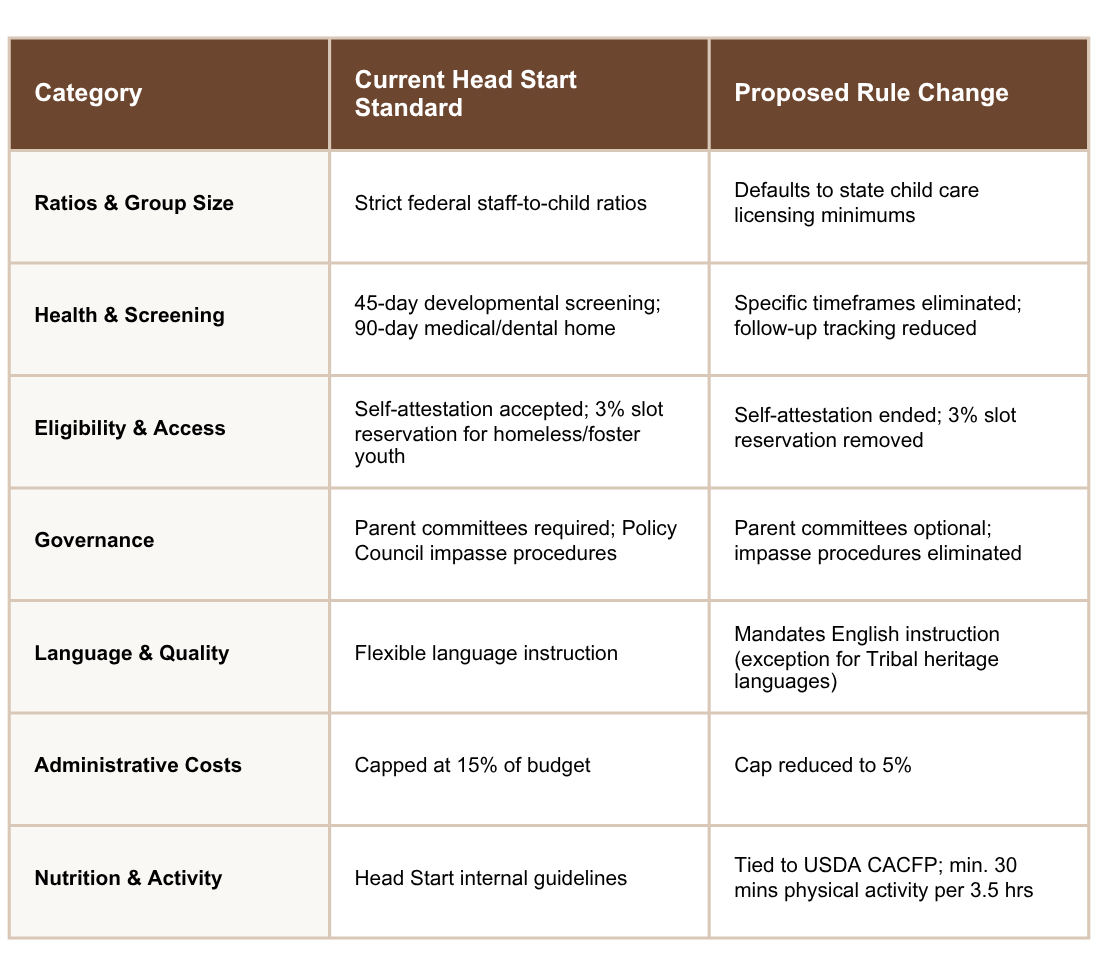
Supporters of the proposal argue that reducing federal requirements would give local programs greater flexibility and allow existing funds to serve more children. That is an understandable goal. There are families in every state who need care, and expanding access should be a shared priority.
The question is not whether more children should be served. They should. The question is whether programs can serve more children well when they are expected to do so with substantially fewer resources per child and fewer federal safeguards.
What this means for families. Some of these changes may sound technical. In practice, they can determine whether a family can enroll quickly, whether a developmental concern is identified early, whether a classroom has enough adults to respond safely to children, and whether a program has the staffing and infrastructure to operate at all. Consider a parent who has recently lost housing and is staying in a motel with a three-year-old child. Under current rules, the parent may be able to self-attest to their circumstances while the program helps gather documentation. Programs also reserve a small share of slots for children experiencing homelessness or foster care.
Under the proposed rule, both of those pathways would be removed.
The family may still technically qualify for Head Start. But eligibility on paper is not the same as access in real life. A parent without a stable mailing address, storage for records, transportation, paid time off, or reliable internet may not be able to prove eligibility quickly enough to use the program when it is needed most.
That distinction matters—not just to one family, but to schools, shelters, employers, local health systems, and communities that are already responding to the consequences of family instability.
What not to do. This is a proposed rule, not a final one. Programs should not alter staffing, classroom size, health practices, enrollment procedures, or governance structures based on this proposal. Any final rule would need to be issued after the public-comment process and would include an effective date.
Submit a comment:Regulations.gov— Docket ACF-2026-0595
Read the proposed rule:Federal Register — RIN 0970-AD30
Why Head Start Affects Everyone
It is easy to think of Head Start as a benefit that belongs only to the children enrolled in it. But Head Start is part of the infrastructure that makes communities function. When that infrastructure is strong, its effects often feel invisible. When it weakens, the consequences show up everywhere else.
It affects the local workforce. For many families, Head Start is the child care arrangement that makes work possible. A parent who can safely leave a child in a reliable program is more able to accept a job, keep a shift, complete training, attend medical appointments, or respond to an emergency. That affects more than individual families. It affects the workforce at hospitals, restaurants, schools, warehouses, small businesses, public agencies, and care settings. The person who can make it to work because their child has a safe place to be may be your coworker, your child’s teacher, the person caring for an aging parent, or the employee a local business cannot afford to lose. Child care is not a private family issue with private consequences. It is a workforce issue.
It affects local employers and economies. Head Start programs employ teachers, family advocates, bus drivers, health staff, food-service workers, administrators, home visitors, and support personnel. They purchase food, supplies, transportation, insurance, maintenance, and services in their communities. When programs are forced to reduce staffing, consolidate classrooms, shorten hours, or close sites, the impact does not stay inside the building. It affects local jobs, local vendors, family income, and the availability of care for working parents. A Head Start classroom is not simply a classroom. It is part of a local economic ecosystem.
It affects K–12 schools and taxpayers. Developmental, hearing, vision, behavioral, and health concerns do not disappear when they are not identified early. They often surface later—when children enter kindergarten and schools are asked to respond with fewer options and at higher cost. A child who misses early screening and support may eventually need more intensive services through a school district, special education system, health provider, or crisis-response system. Those systems are essential, but they are often more expensive and less effective when needs are addressed only after they have become more urgent. The public question is not simply, “How much does Head Start cost?” It is also, “What does it cost when children and families do not receive support until much later?”
It affects community stability. Head Start connects families to health care, nutrition, disability services, housing resources, mental-health supports, parenting education, and other local systems. For families facing instability, that connection can be the difference between a short-term crisis and a longer-term disruption. Programs do not solve every problem. But they often serve as an early point of contact—one of the few places where a family may be known well enough for someone to notice that a child needs help, a parent has lost housing, or a health concern has gone untreated. When those connections become optional or under-resourced, communities do not become less responsible for those needs. The responsibility simply moves elsewhere.
It affects the care available to families who do not qualify. Head Start and private child care programs share the same local labor market. They recruit from the same pool of teachers, compete for the same facilities, navigate the same insurance and food costs, and operate within the same fragile early childhood workforce. If Head Start standards and compensation weaken, that can place additional pressure on the entire care ecosystem. Families who pay private tuition may experience that through longer waitlists, fewer available classrooms, higher turnover, or rising prices. The child care market is not divided into separate worlds. Head Start, public preschool, family child care, nonprofit centers, and tuition-based programs all depend on the same workforce and the same community infrastructure.
States Taking Action
One federal floor could become 51 different floors
The proposed rule would make state child care licensing standards the operative requirements for teacher-child ratios and group sizes in many cases. That may sound like a minor administrative shift. It is not. Current Head Start standards establish a national baseline:
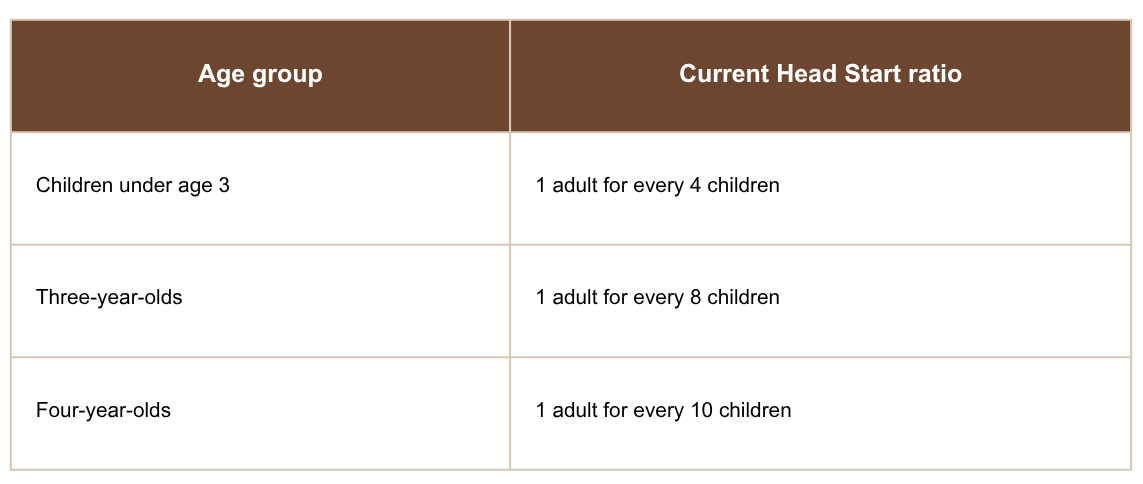
State child care licensing standards vary widely.
The Children’s Equity Project and the National Institute for Early Education Research compared current Head Start requirements with state licensing standards in all 50 states and the District of Columbia. Their analysis found that 80% of children currently enrolled in Head Start and Early Head Start would experience worse staff-child ratios if programs defaulted to state licensing minimums.
For two-year-olds, ratios would at least double in 24 states. Only 12 states license child care at Head Start’s 1:4 ratio for one- and two-year-olds. For children around age two-and-a-half to three, only Connecticut, Massachusetts, and West Virginia match the current Head Start standard. Mississippi and Arkansas, for example, permit ratios as high as 1:12.
This is why national averages can obscure the real question: what would happen in your state?
A federal standard means a child in one state has access to the same baseline protection as a child in another. Replacing that standard with state licensing means a child’s daily experience may depend much more on their ZIP code.
Why ratios matter beyond the classroom
Teacher-child ratios affect whether an adult has time to comfort a distressed child, notice a developmental concern, support a child with a disability, help with toileting, prevent conflict from escalating, or simply have a meaningful conversation.
They also affect teacher burnout, injury risk, turnover, and whether educators can remain in the field.
A ratio is not just a number on a compliance form. It is a description of how much adult attention a child can reasonably receive during the day.
A useful question for your state
Before submitting a public comment, find your state’s licensing ratio for the age groups your program serves. Then ask:
How does it compare with current Head Start ratios?
Would your staffing model change if state licensing became the minimum standard?
Would classroom size increase?
What would happen to children with disabilities, behavioral needs, or emerging developmental concerns?
What would change for teacher workload, turnover, and recruitment?
Could the program still provide the same level of family support, health coordination, and individualized attention?
The most useful public comments are specific about local conditions.
Data Spotlight

50,000 words to 3,600. The reduction in the Head Start Program Performance Standards under the proposed rule, striking more than 1,400 provisions. (NPRM, RIN 0970-AD30)

80%. Share of children currently enrolled in Head Start and Early Head Start who would experience worse staff-child ratios if federal standards defaulted to state licensing. (Children's Equity Project, August 2026)
24 states. Number where ratios for two-year-olds would at least double under state licensing minimums. (NIEER, August 2026)
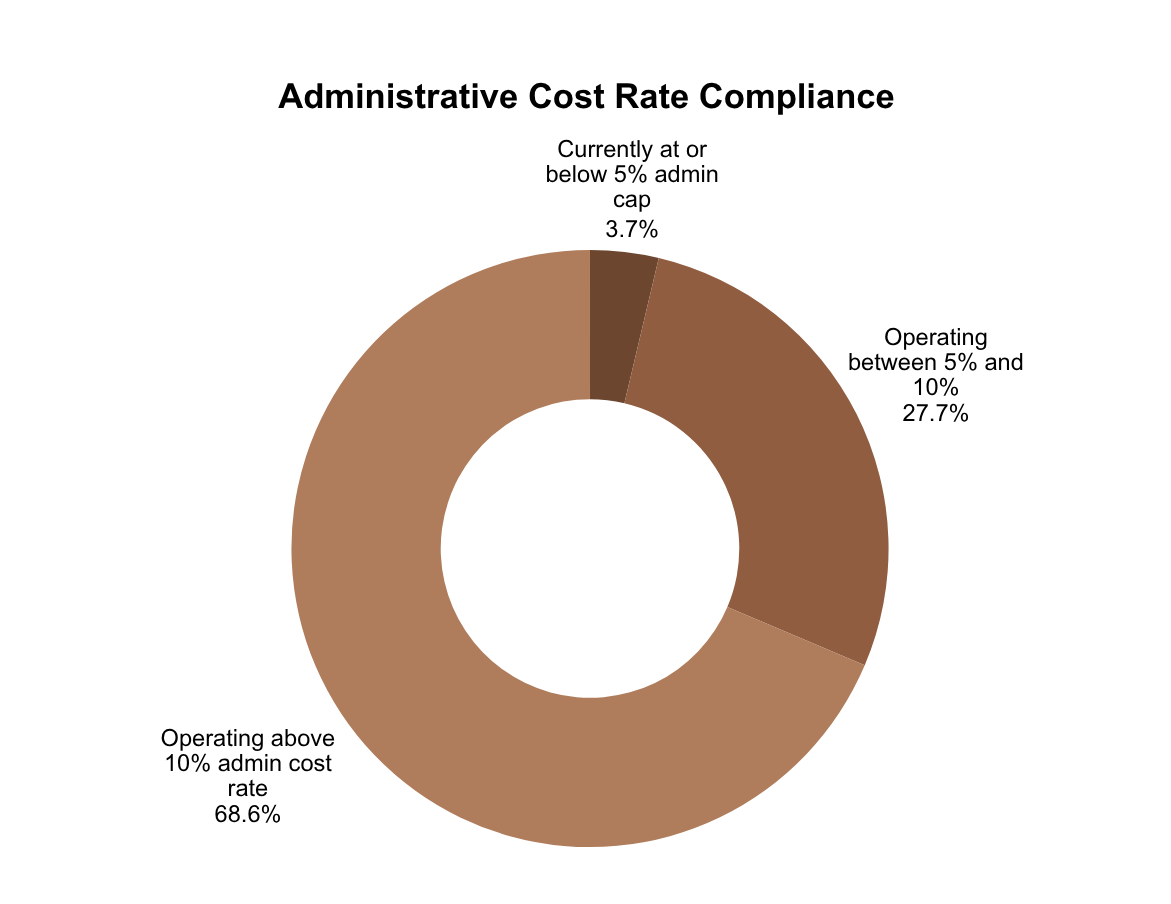
3.7%. Share of Head Start grants currently operating at or below a 5% administrative cost rate, the level the proposed rule would impose. Another 27.7% operate between 5% and 10%. (NPRM Regulatory Impact Analysis)
$754 million. Estimated amount that would need to move out of administrative costs across the program to meet the proposed cap. About half of Head Start grants serve 200 or fewer children, leaving fewer participants across which to spread fixed costs. (NPRM Regulatory Impact Analysis)
$12.3 billion. Annual Head Start appropriation, the federal government's largest single investment in early care and education, serving over 700,000 children and pregnant women. (New America, July 2026)
New Funding Opportunities
📢 George Gund Foundation Capital Grants
Who Should Apply: Nonprofits in Cleveland/Cuyahoga County, OH.
Focus Areas: Systemic change, advocacy, and capacity building around climate, racial/economic inequality, and democracy.
Requirements: BlackBaud ID (GrantsConnect), a "What We Believe" narrative, budget, and financials.
🗓️ Winter Cycle Deadline: November 15, 2026 (Trustee Meeting: Feb 2027)
🗓️ Summer Cycle Deadline: March 15, 2027 (Trustee Meeting: Jun 2027)
📢 Mellon Emerging Faculty Leaders Award
Who Should Apply: Tenure-track assistant professors (typically in their 4th or 5th year).
Focus Areas: Contemporary American history, politics, culture, society, and campus community building.
The Award: $20,000 stipend ($12k for summer research, $8k for academic year assistance).
🗓️Deadline: December 1, 2026, at 5:00 PM ET.
Research & Best Practices
Featured: Lowering the Bar
The Children's Equity Project at Arizona State University compared Head Start Performance Standards with state child care licensing regulations, published alongside the proposed rule. They found the two systems serve different goals: licensing prevents harm by setting minimum safety standards, while performance standards aim for developmental quality. The report highlights gaps, especially in teacher-child ratios, workforce qualifications, language access, disability inclusion, and protections against suspension and expulsion. Some findings may surprise those who think health and safety rules are consistent: only about a third of states require smoke detectors, and eighteen test for lead in drinking water.
Takeaway for practitioners and advocates. If you are drafting a comment, an op-ed, or testimony, pull the specific figure for your state rather than the national average. State-level specificity is what makes a comment part of the substantive record an agency must respond to.
Meeks et al. (2026). Lowering the Bar: An Analysis of How Replacing Head Start Standards with State Child Care Licensing Weakens Early Learning Across the United States. The Children's Equity Project, Arizona State University. Read the report
Developmental Timing and Long-Term Impact of Educational Opportunity
This 26-year longitudinal study finds that providing educational opportunities to children in low-income households significantly boosts their long-term educational attainment and adult earnings across all stages of growth—early childhood, middle childhood, and adolescence. Rather than a single critical window, sustaining educational investments continuously throughout childhood yields the strongest adult outcomes.
Takeaway for Practitioners & Advocates: When advocating for funding or programming, emphasize that early childhood investments are crucial, but sustained support through middle childhood and adolescence is required to maximize long-term mobility.
Dearing, E., Zachrisson, H. D., Bustamante, A. S., & Vandell, D. L. (2026). Developmental Timing of Educational Opportunities for Children in Low-Income Households. Educational Researcher, 0013189X261463238. https://journals.sagepub.com/doi/pdf/10.3102/0013189X261463238?casa_token=8Ag0xW422tQAAAAA:IXSFppFLCvavNdC5RlcA2Yzvcxp8QQB8Awfn1TjgH3iznDCDkzBIeHMRTJ4__wHs0qd7WRAiWXOr
Also worth reading. Healy, M.R. & Barnett, W.S. (2026). The Race to the Bottom: What Replacing Head Start's Staff-to-Child Ratios Standards with State Child Care Minimums Would Mean for Children in Poverty. NIEER, Rutgers University. A three-page version of the ratio analysis, useful for sharing with board members and elected officials who won't read ninety pages. Read it here.
Education & Engagement
A public comment does not need to sound like a legal brief. It can be short, personal, practical, and specific. The strongest comments tend to include:
Who you are and how you are connected to children, families, programs, schools, businesses, or the community.
What you see in your state or local area.
Which proposed change concerns you.
What would happen in practice if that change were implemented.
What you want HHS to retain, revise, or reconsider.
Submit a public comment:Regulations.gov— Docket ACF-2026-0595
Read the proposed rule:Federal Register — RIN 0970-AD30
A Simple Guide to Submitting a Public Comment(Start Early) A plain-language walkthrough with a sample comment you can personalize. Written for people who have never commented on a federal rule and don't intend to become experts. Topic-specific templates covering disability, maternal health, and dual language learners are being released on a rolling basis. linktr.ee/headstartnprm
Parent and Caregiver Sign-On Letter(Start Early) For families with a child currently enrolled. Includes a Spanish translation and a separate comment template. Sign-on deadline: September 25, 2026, ahead of the October 6 comment close.
Proposed Head Start Rule and Children Experiencing Homelessness(SchoolHouse Connection) A provision-by-provision chart comparing statute, current regulation, and the proposed rule for children experiencing homelessness and children in foster care. Organizations drafting their own comments are welcome to adapt it. Published August 10, 2026.
Congressional Outreach Toolkit Guidance on requesting district office meetings and hosting program site visits, with sample invitation language. Find your delegation at congress.gov/members/find-your-member.
Upcoming Professional Engagements
A few dates for your September calendar:
September 3rd: SRCD conference submission deadline. SRCD will be held in Atlanta, GA April 8-10, 2027. The call for proposals is out with submissions due September 3rd:
September 25:Phoenix Children's Trauma Con 2026 — Phoenix, Arizona. Focused on trauma-informed care strategies, pediatric resilience, and best clinical practices for supporting vulnerable children.
September 28:The C.A.R.E. Summit — Tuscaloosa, Alabama / virtual.Explores community-based advocacy, resources, and collaborative interventions to support vulnerable families and early childhood well-being.
September 29–30:2026 National Home Visiting Summit — Baltimore, Maryland. Brings together home visiting professionals and leaders to advance evidence-based family support programs and system improvements.
September 29:ACMH 36th Annual Conference — Lansing, Michigan. Professional and family-centric conference for family-driven care, youth mental health support, and advocacy strategies across Michigan’s care systems.
September 29:Family Crisis Center Conference — Ringgold, Georgia. Covers trauma-informed practice, domestic violence intervention, and community-level crisis prevention for children and families.
A Note From Our Team
A colleague asked recently whether submitting a public comment on a federal rule really accomplishes anything. The honest answer is: it depends on what you mean by accomplish. It will not, by itself, stop a rule. But that is not the same thing as saying it does nothing.Substantive comments become part of the administrative record. Agencies are expected to review and respond to significant issues raised during the comment period. Those responses can shape the final rule, influence implementation, inform congressional oversight, support litigation, and create a public account of what communities said—and what the government did with that information.
That process is slower than most of us would like. It is rarely satisfying in the moment. But public systems are shaped not only by the people with the loudest platforms, but also by the people willing to document what is happening where they live and work.
If this proposal affects your program, your state, the families you serve, your workforce, your school district, your local economy, or your community’s future, your experience belongs in the record.
And if you understand the financial side of this issue—if you have built a budget, managed a program, navigated a staffing shortage, handled transportation costs, balanced a facilities crisis, or watched families lose access when classrooms close—please consider putting that knowledge in writing. The public conversation needs more than broad statements of support or opposition. It needs the practical truth of what these decisions mean on the ground.
As the children of our team members return to classrooms and many of our colleagues begin another school year as teachers, program leaders, administrators, and advocates, we are wishing everyone a steady, hopeful, and successful start to the year ahead.
With gratitude,
The ECS Team 🤎