ECS Exchange | July 2026
Choosing Stability in the Face of Federal Volatility.
Welcome to the July edition of the ECS Exchange!
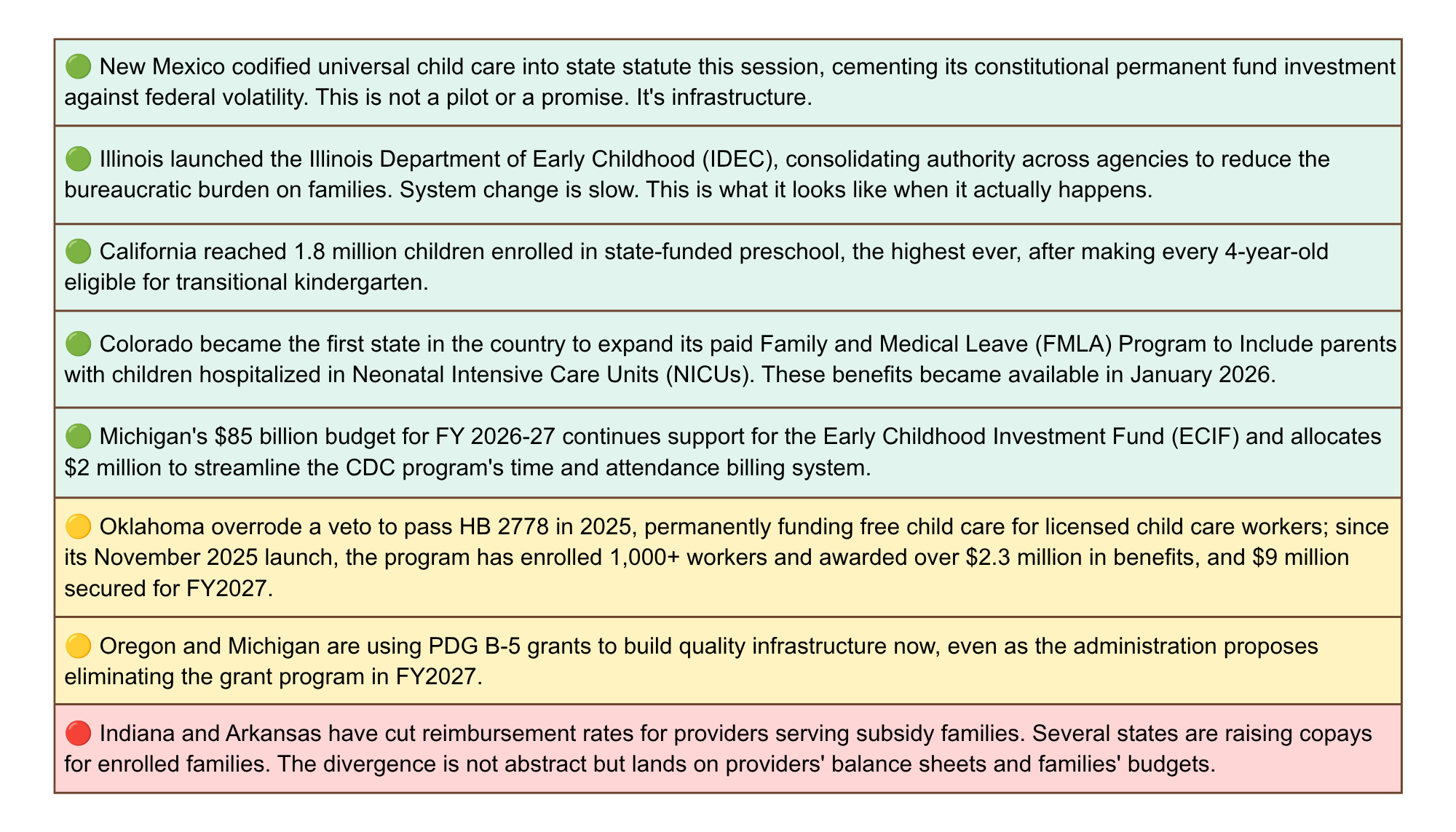
Across the country, state leaders are choosing stability. They’re building durable, long-term infrastructure in the face of federal volatility. From legislative consensus in New Mexico to gubernatorial action in Illinois, states are taking the lead, innovating and building for children and families.
In other news, ECS is celebrating turning five. Reflecting on our journey from a solo consultancy to a team of ten, we’ve learned that sustainability is the true bedrock of impact. We’re thrilled to share our most recent additions: Mabinty and Drew! You can find Jennifer’s reflection on ECS’s journey here.
States Taking Action
Federal actions matter but states wield the power to act. The 2026 CCDF Final Rule took effect earlier this month taking away the 2024 CCDF Final Rule requirements to lower child care costs for families participating in CCDF, improve the program's child care provider payment rates and practices, and simplify enrollment practices. But some states continue to innovate and work in service to the children and families depending on their leadership. Here's what's worth tracking right now:
Want to see exactly how federal funding flows to your state? FFYF's CCDBG State Fact Sheets are the resource for that. And their CCDBG Toolkit is built for sharing that information with your network and your congressional delegation.
Policy updates:
OMB proposed rule, “Regulation for Federal Financial Assistance”
The White House Office of Management and Budget (OMB) proposed a major rule regarding federal grants and financial assistance that has generated immense controversy and concern across the American scientific community. The proposed rule, Regulation for Federal Financial Assistance, would fundamentally overhaul how federal agencies (such as the NIH, NSF, and NASA) distribute and manage up to $1 trillion in grant funding.
Why this matters?
While this rule affects scientific grants, the overhaul of federal grant management sets a precedent for how federal agencies, including those funding early childhood initiatives, will distribute and manage funds. The public comment period closed on July 13, 2026, with nearly 500,000 comments. We can still act, contact your members of congress and demand keeping politics out of science. Demand that your elected officials protect the US’s position as the global leader in scientific integrity and advancement.
The scientific community, including organizations such as the American Association for the Advancement of Science (AAAS), universities, and numerous Nobel laureates, oppose this change, warning the rule could dismantle peer-review practices and threaten U.S. leadership in science. The administration aims to finalize the rule by October 1, 2026. Meanwhile, lawmakers have introduced amendments to block its implementation.
Read more at the following links:
🔗 What happens now that comments have been submitted on the devastating OMB rules?
🔗 U.S. researchers outraged at proposed changes to federal grants
Workforce Stability: The Head Start Wage Connection
The 2026 Notice of Proposed Rule Making (NPRM) is intended to roll back requirements adopted in the 2025 Head Start Final Rule. This proposal would roll back requirements for:
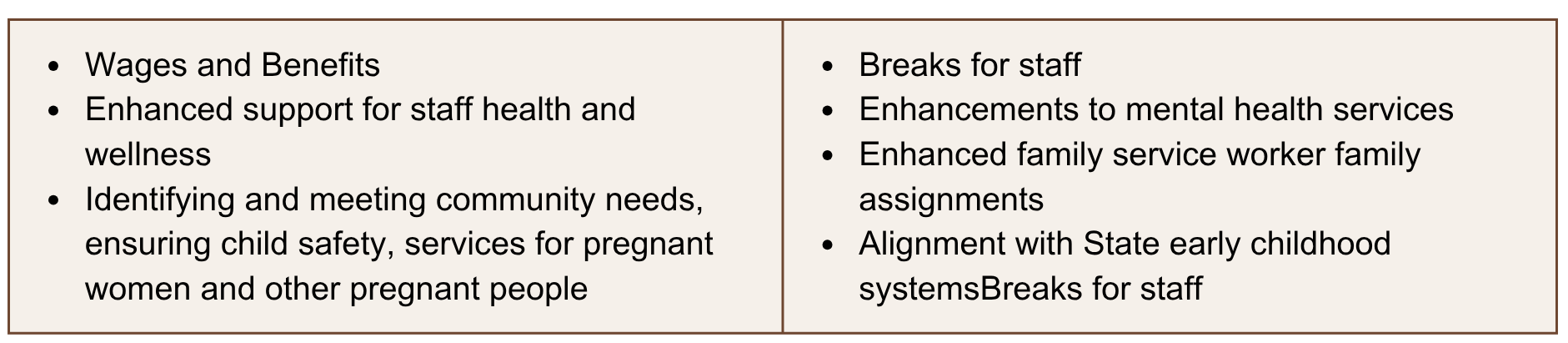
But it’s not too late to protect Head Start and the newly adopted high standards. While the comment period closed in June, 2026, you can still contact your members of congress to demand that these positive changes remain untouched.
The National Institute for Early Education Research (NIEER) released new research: The Real Cost of Rolling Back Head Start Wage Requirements, highlighting a critical tension in our field: wage standards are a major component of workforce stability. As states work to build more durable infrastructure in the face of federal uncertainty, this report serves as a timely reminder that undermining compensation standards for Head Start educators risks destabilizing the very 'human ecosystem' of care that we rely on for long-term program quality.
To stay on top of changes and see how you can engage, we recommend reading Child Care Choice Guarantee and following Katie Hamm who demystifies the process and breaks down wonky language so we can all be informed and act accordingly.
New funding opportunities
📢 Grant Opportunity: The Richard E. & Nancy P. Marriott Foundation – Education & Human Services Grants
Funds general operating costs for 501(c)(3) nonprofits in early childhood development and gainful employment, open to organizations in DC, Montgomery County (MD), Utah, or New Hampshire. First-time requests typically run $5,000–$10,000; the foundation awards roughly $1.8M annually across ~150 grants.
Deadline: August 1 at noon; notifications in November.
📢 Grant Opportunity: George Gund Foundation Capital Grants
George Gund Foundation — Capital Grants. For Cleveland/Cuyahoga County, Ohio nonprofits working on systemic change, advocacy, and capacity building around climate, racial/economic inequality, and democracy. Requires a BlackBaud ID for GrantsConnect plus a "What We Believe" narrative, budget, and financials.
Winter 2027 Cycle: November 15, 2026 (Trustee Meeting: February 2027)
Summer 2027 Cycle: March 15, 2027 (Trustee Meeting: June 2027)
A New Study: Aligning Subsidy Policy with Equitable Access
Who is actually being served by centers that accept child care subsidies?
A new study examining data from the National Survey of Early Care and Education finds that state-level CCDF policy decisions are a key driver in shaping access for priority populations. The researchers identified distinct profiles of child care centers, ranging from those providing a wide breadth of services to those more narrowly focused on specific family needs, and found that state policies directly predict differences in which populations (by race/ethnicity and disability status) centers can serve.
Takeaway: This research shows subsidy policies are tools for equity, not just administration. States can improve access by auditing their subsidy requirements to see if they match their priority populations' needs.
Education & Engagement
A Local Look at Infant-Toddler Systems
In May 2026, the Adams County Early Childhood Partnership released a policy brief mapping gaps and opportunities in local infant-toddler care, co-authored by ECS’s very own Drew McGee, alongside Jenn Finders of Colorado State University and Lisa Jansen Thompson of the Early Childhood Partnership of Adams County. For county or state workers, this resource exemplifies using localized data for advocacy and systems alignment. It provides a practical view of service deserts and the potential to coordinate funding to support young learners and families.
Read the brief: Adams County Infant-Toddler Policy Brief (May 2026)
Time for R.E.C.E.S.S., Time for Action!
As members of Congress head home for the August recess, early childhood advocates have a key window to connect decision-makers directly to local ECE realities. The National Association for the Education of Young Children (NAEYC) released their August R.E.C.E.S.S. Toolkit to help you:
Explore the full toolkit: https://www.naeyc.org/sites/default/files/wysiwyg/user-174467/afee-2026-summer-recess-toolkit-final.pdf
National Collaborative Toolkit for Infants & Toddlers PN-3 Advocacy Messaging Toolkit
The PN-3 Advocacy Messaging Toolkit helps advocates with evidence-based messaging and strategies. It highlights early childhood's importance, offers proof points, and practical advice to unite support for policies benefiting young children.
Explore the full PN-3 Toolkit here: https://ncit.org/resource/the-pn-3-advocacy-messaging-toolkit/
Upcoming Professional Engagements
Navigating this year requires both rigorous data and community-honoring design. Here are two upcoming conferences:
ZERO TO THREE LEARN Conference 2026 (October 27–29, Portland, OR): A cross-sector convening for educators, mental health leaders, researchers, and advocates, one of the few spaces where infant-toddler policy and practice sit at the same table.
DEC's 42nd Annual International Conference on Young Children with Disabilities and Their Families (October 26–29, Omaha, NE): A key convening for the early intervention and early childhood special education field.
NAEYC Annual Conference (December 5–8, Washington, DC): A rich mix of research-based and practical sessions on early learning, innovation, and evidence-based practices.
A Note From Our Team
Five years in, we're still a little amazed by how far this has come, from one person to a team of ten, with Mabinty and Drew now officially part of the crew. Growth like this only means anything if it's built to last, and that's exactly the bet we're making as we head into a busy season.
Thank you for reading, for sending in your stories, and for doing the work that makes all of this worth writing about.
— The ECS Team 🤎