
Freedom Is a Behavior, Not a Document
Unfinished Freedom: The Distance Between Paper and Practice
Sitting here with a heavy heart, again.
I am struck by the same uncomfortable truth: freedom declared and freedom delivered have never been the same thing. I find myself reflecting on the gap between the freedom we celebrate and the freedom that remains unfinished. As we commemorate the delayed arrival of liberation in Texas in 1865, news that took more than two years to reach the people it was meant to free, I am reminded that words run hollow when actions contradict them.
Freedom is a behavior, not a document. Laws may change on paper, but emancipation is something we have to keep choosing, keep extending, and keep living out. The walls do not fall on their own.
Juneteenth asks us to honor how far we, have come, and to be honest about the distance still left to travel.
About Juneteenth
On June 19th, 1865, some 2,000 Union troops arrived in Galveston Bay, Texas, to announce what had already been declared true for more than two years: that the over 250,000 enslaved Black people in the state were free. The Emancipation Proclamation had taken effect in 1863, but in Texas, the westernmost Confederate state, it could not be enforced without a military presence. Freedom was real on paper long before it was real in practice. This is the origin story of Juneteenth—what many recognize as our country’s second Independence Day.
The road to official recognition was long. Texas made Juneteenth a state holiday in 1979, but it took 40 years for Pennsylvania to become the second state to do so in 2019. Following the global reckoning after the murder of George Floyd, Virginia, New York, and New Jersey quickly followed suit. By the next year, Illinois, Louisiana, Maine, and Washington brought the total to nine states, paving the way for President Biden to declare it a federal holiday. Today, Washington, D.C., and 33 states recognize Juneteenth as a permanent state holiday with paid time off, while the remaining 17 states mark it as an official day of observance.
This year, the Association for the Study of African American Life and History (ASALH)—the organization founded by Carter G. Woodson, who gave us Black History Month—is asking leaders and students to reflect on the theme: “What freedom looks like, yesterday, today, and tomorrow.” It is a question rooted in education, community, and the ongoing work of emancipation. Freedom is not a static historical event; it is a living, daily practice. It is the exact same question we must bring to our professional work each and every day.
The House We Build
It is within this tension that I think about the house we are building at Early Childhood Solutions, and whether we are truly living up to the freedom we claim to champion. We consistently push each other to challenge the status quo and find the most effective, equitable paths toward our mission.
I set out to build a team that holds the greatest expertise and talent in early childhood policy, programs, and measurement. To do that, we have been deeply intentional about finding that talent across diverse lived experiences. We refuse to rely on shallow first impressions or on conventional, structural assessments of competency. Rather than sorting candidates purely by traditional degrees and titles held, we define our needs together. We build a team where each person is beautifully surrounded by those who do not think exactly like them, but are entirely motivated by the same mission.
In many industries, there is a painful distinction between the "Front of the House" (the visible face shown to clients and funders) and the "Back of the House" (the operational engine room). Too often, the professional world mirrors a caste system where we relegate brilliant minds to the "back" because they do not fit a certain corporate aesthetic or traditional pedigree. Professional mobility is not possible if foundational roles are inaccessible as those foundational roles. These early career roles are critical to learning and practice which leads to skill building and an ability to cultivate expertise over time.
You hear it in a familiar line from hiring managers and across teams: "I want to hire diversely, but I just can't find qualified candidates who don't look like me." When we lean on sameness, we are asking for the exact same status-quo results. The talent is there. If we cannot see the talent, it is not because it doesn't exist—it is because our own lens is obscured. Is that because inaction is comfortable even if dehumanizing?
What We Practice vs. What We Produce
Here is the irony I cannot get past. In our field, we are incredibly intentional about survey design. We obsess over research methodologies that responsibly capture diverse views; we agonize over sample sizes to ensure every community is accurately represented.
Then, we treat that care as a feature of the paperwork, not of ourselves. We demand diversity in our spreadsheets while tolerating homogeneity in our boardrooms. We ensure the "diverse view" is captured on a survey, yet we leave that perspective behind when it comes to actual leadership, strategy, and compensation. Why do we value the data of those who are different, but not their presence?
The Data: A Mirror of Inequality
The numbers for 2024–2026 prove that the "lack of qualified talent" narrative is an absolute myth. The education is there, but the career mobility is not. When you look at the raw numbers provided by the Economic Policy Institute’s (EPI) Current Population Survey (CPS) extracts, tracking racial disparities within identical educational cohorts, the structural penalty becomes impossible to ignore.
Average Hourly Wages by Education, Gender, and Race

The 'Bootstrap' Myth: Core Realities
The Wage Floor Convergence and the Black Labor Penalty: At the High School level, wages across all groups are compressed closer together by minimum wage floors. However, even within this tightly bound floor, Black workers face immediate structural penalties. A High School-educated Black man earns $21.80 per hour—more than $7 less than a White man with the exact same education. Meanwhile, a Black woman at this level averages $18.50 per hour, facing the compounding squeeze of a low wage ceiling that sits just pennies above her Latina peers ($18.10).
Disparities Explode with Degrees: The assumption that higher education acts as an equalizer is completely upended by the data. Once a Bachelor's degree is introduced, the absolute dollar spread widens into a chasm. A White man with a Bachelor's degree averages a commanding $54.80 per hour. In stark contrast, a Black man with a Bachelor's degree makes just $38.20 per hour—failing to even cross the $40 threshold. The penalty is even harsher for Black women, who average $33.50 per hour ($32.10 for Latina women). This means a Black woman with a college degree makes roughly $21.30 less per hour than a White man with the exact same credential, resulting in an annual deficit of more than $44,000 for full-time work.
The Intra-Gender and Intra-Race Racial Gaps: Education fails to standardize wages even when isolating a single gender or race, exposing deep layers of systemic bias. Within the female workforce, a White woman with an advanced degree makes $53.20 per hour, whereas a Black woman with an advanced degree averages $44.80 per hour (and a Hispanic woman averages $43.90). This means highly educated women of color face steep earnings deficits even when compared exclusively to other women with identical credentials.
The Ultimate Price of Whiteness: A profound racial barrier exists across genders: Black men with advanced degrees ($51.90) and Black women with advanced degrees ($44.80) are both paid less on average than a White man who holds only a Bachelor's degree ($54.80). This highlights a labor market where the premium placed on Whiteness routinely outvalues the premium placed on advanced Black educational achievement.
Unemployment Rates by Education, Gender, and Race
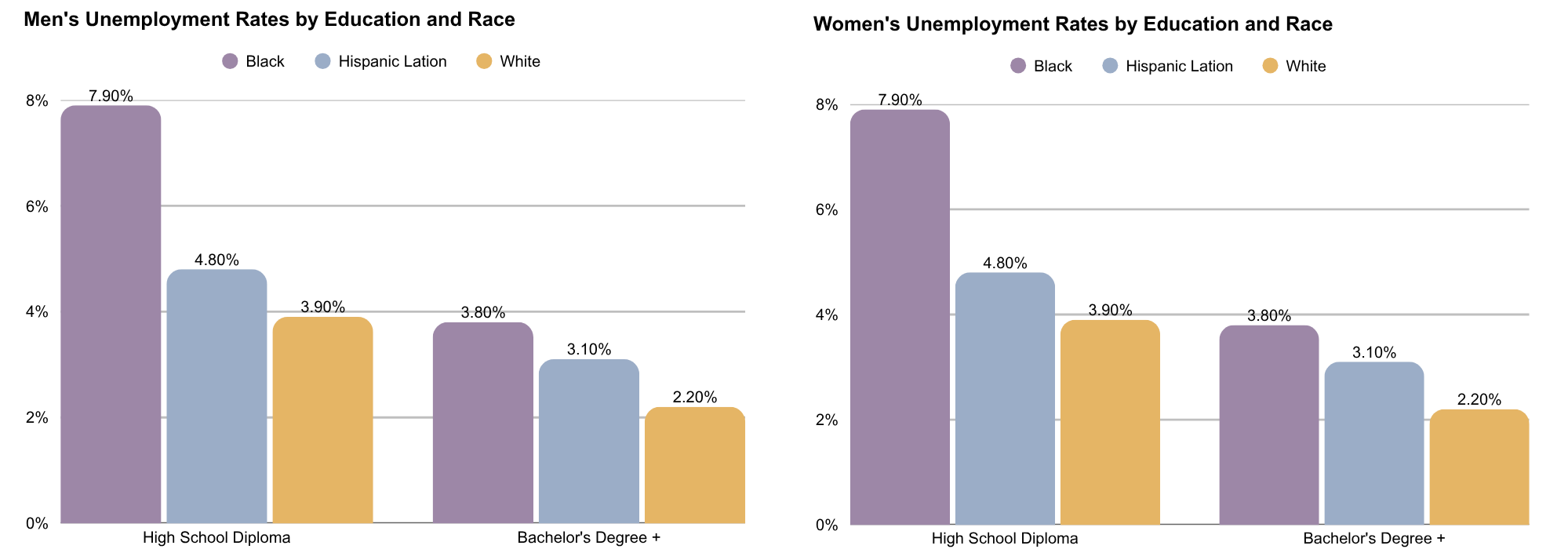
The High School Labor Trap: At the High School-educated level, the racial gap is at its widest. Black men without college access suffer an unemployment rate of 7.9%—a rate typically associated with a broad economic recession—even when the macroeconomy is stable. This points directly to the vulnerability of the industries where workers without degrees are concentrated, combined with structural biases in initial hiring choices.
The Educational Shield: The most prominent takeaway is that moving from a High School diploma to a Bachelor's degree dramatically reduces unemployment vulnerability for every demographic group. For instance, the unemployment rate for Black men drops from 7.9% down to 3.8% with a college degree, and for Latina women, it falls from 5.0% to 3.3%. Earning a degree remains one of the single most reliable protections against total joblessness, but not protections from lower pay, fewer opportunities for growth, or the emotional and creative security associated with job security.
The Stagnant Racial Ratio: Even though higher education lowers the overall numbers, the relative disparity between racial groups remains rigidly intact. Within the Bachelor's degree tier, a Black man (3.8%) is still roughly 1.7 times more likely to be unemployed than a White man (2.2%). Similarly, a college-educated Black woman (3.4%) faces a significantly higher rate of joblessness than a college-educated White woman (2.3%).
A Call to Reflective Action
This Juneteenth, we must look closely at our professional houses. If demographic diversity is important in our research data, why is it routinely omitted from our employment practices? When hiring managers say they “can’t find qualified candidates of color,” is it because they aren’t really looking? Or is it because when they do, they attempt to shortchange those candidates? The data tells a story of structural exclusion, not a lack of talent.
Look across our industries and the question becomes completely unavoidable: Why are the economic disparities so vast? Is writing code inherently more skillful than teaching a child to read? Are medical procedures higher risk than keeping a medically fragile infant alive? If you want to understand how comparable skills are devalued based on profession title, read this.
The economic math doesn't add up because it was never based on merit—it was built on bias. Repairing these deep systemic wrongs requires a deliberate shift from individual accountability toward collective power. We don't have to wait for massive corporate systems to change before we start moving the needle. We can start exactly where we have immediate power. We can start at home.
Audit Your House: Look honestly at who represents your company to the world. Is it a diverse representation of the talent you claim to value, or a comfortable mirror of yourself? Who do you place in roles and who do you grow in those roles?
Bridge the Irony: You cannot obsess over diverse data and simultaneously tolerate homogeneous leadership. If you demand diverse perspectives in your research samples, you must demand them in your executive hiring and partnerships.
Question Your Partners: Look beyond your own walls. Who do your vendors, contractors, and partners put at the front of the house, and who do they keep hidden in the back? Your partnerships are an extension of your company's values. How are those values looking out in the real world?
We have spent too many generations overlooking the brilliance right in front of us. There is no better time than now to design a different path—one where we recognize that our shared future is only better when we intentionally move talent out of the shadows and into seats of actual power.
Freedom shows up in how we behave, not just in the data we collect. It lives in the decisions we make small and large, across days, years, and generations.
☮ Peace
*Thank you to Dr. Chrishanna Lloyd, Dr. Iheoma Iruka, and Dr. Stephanie Curenton for providing feedback to improve my thinking and articulation of my thinking across my work and in this reflection.
Recommended Watching
Friday, O., Gill, N., & Wolfe, R. (2024). Grow Your Own ECE: Partnerships and Pathways [Webinar]. National Early Care and Education (ECE) Workforce Center / Build Initiative.
Friday details community-driven, equity-centered strategies to build pathways for early childhood educators of color challenging systems to recognize and elevate the brilliant "talent that already exists from within" rather than enforcing conventional, exclusionary pedigrees that trap Black and Brown educators.
Lloyd, C. M. (2023). Meeting the Needs of the Early Childhood Workforce: National Perspectives [Webinar Transcript]. Preschool Development Grant Birth through Five Technical Assistance (PDG B-5 TA).
Stresses the importance of increasing compensation and benefits for a diverse early childhood workforce and challenging systems to move beyond just demanding credentials and instead build viable, highly compensated career pathways that move educators of color out of economic insecurity.
Lloyd, C. M., Carlson, J., & Shaw, S. (2022). [Webinar]. Mary Pauper, A Historical Exploration of Early Care and Education Compensation Policy, and Solutions, Early Educator Investment Collaborative (EEIC).
Stresses the importance of increasing compensation and benefits for a diverse early childhood workforce and challenging systems to move beyond just demanding credentials and instead build viable, highly compensated career pathways that move educators of color out of economic insecurity.
Recommended Reading
Goffin, S. G., & Mitchell, M. C.(2019). Moving Beyond False Choices for Early Childhood Educators. Open Society Foundations / New America Compendium.
Mitchell interrogates the structural gatekeeping mechanisms that penalize Black and Brown educators, advocating for policy changes that offer true career mobility and fair compensation over empty credentials.
Hill, Z., Taylor, S., Kolack, D., Maldonado, G., Davis, B., Medina, B., ... & Bogard, K. (2022). Resident-Led Research Policy and Power (RRPP): A Framework for Centering Community Voice in Participatory Research. Progress in Community Health Partnerships: Research, Education, and Action, 16(2S), 95-103.
Hill’s RRPP framework functions as a direct counter-measure, offering an operational method that stops extractive research and instead centers local Black and Brown residents as leaders and co-designers of the policy itself.
Iruka, I. U., Durden, T. R., Escayg, K.-A., & Curenton, S. M.(2023). We Are the Change We Seek: Advancing Racial Justice in Early Care and Education. Teachers College Press, Columbia University.
This text blends theoretical frameworks with aggressive, practical guidance on how early care systems can move away from merely collecting data on marginalized children and instead implement racially inclusive workforce structures, fair compensation, and equitable hiring.
Iruka, I. U., James, C., Reaves, C., & Forte, A.(2021). Black Child National Agenda: America Must Deliver on its Promise. Equity Research Action Coalition at UNC Frank Porter Graham Child Development Institute & National Black Child Development Institute (NBCDI).
10 structural action steps to dismantle institutional racism, including addressing harsh discipline disparities against Black preschoolers, closing wage gaps for educators of color, and investing in Black-led early care systems.
Lloyd, C. M., Carlson, J., Barnett, H., & Shaw, S. (2021). Mary Pauper, A Historical Exploration of Early Care and Education Compensation Policy, and Solutions, Child Trends.
How systemic racism, sexism, and policy-driven oppression devalue the early childhood workforce through severe wage disparities. To counter these inequities, the authors developed actionable, equity-centered recommendations for policymakers, practitioners, and funders to transform compensation, preparation, and stability for a diverse early childhood workforce.
Lloyd, C. M., & Sanders, M. (2024). A 100-Year Review of Research on Black Families. Child Trends.
A review of ten decades of social science research focused on Black families that draws on historical, systemic, and economic contexts to understand how research connects to policies, programs, and Black families. This piece can be used as a guide for funders and policy leaders to move past surface-level data and to better understanding of how research shapes policies, programs, and the lived experiences of Black families and communities.
Sykes, M. (2014). Doing the Right Thing for Children: Eight Qualities of Leadership. Redleaf Press.
The Alignment: Sykes explicitly tackles the concept of "the house we build" from an executive and ethical standpoint. He writes heavily on the obligations of early childhood leaders to possess character, competence, and courage, challenging organizations to look beyond traditional pedigree and ensure that leadership reflects true equity rather than comfortable institutional sameness.
And more, always more
Meet Me at the Libraryby Shamichael Hallman: A poignant look at how our communal spaces serve as the heartbeat of visibility and care, bridging socioeconomic divides to promote a healthy democracy.
Caste: The Origins of Our Discontentsby Isabel Wilkerson: A vital look at the unspoken systems that keep people in the "back of the house."
The Sum of Usby Heather McGhee: An insightful analysis of how building for "all" benefits everyone, moving us away from zero-sum thinking.
We Will Be Jaguars: A Memoir of My Peopleby Nemonte Nenquimo: A Waorani leader from the Amazonian rainforest of Ecuador, Nenquimo provides a gripping account of her journey to becoming an internationally recognized activist. It is a call to see the expertise of those who have successfully stewarded the world’s most vital ecosystems for millennia and a masterclass in resisting the "caste system" of global industry.
This Mouth Is Mineby Yásnaya Elena Aguilar Gil: A brilliant Mixe linguist and activist from Oaxaca, Mexico, Aguilar Gil writes with wit and precision about the "invisible" structures of the nation-state. Her work explores how Indigenous people are often treated as "heritage" rather than active political and intellectual agents.
References
Economic Policy Institute. (2025). The gender pay gap widened slightly in 2025: How structural policy choices hurt women and what states can do to fix it. EPI Data Library.https://www.epi.org/blog/the-gender-pay-gap-widened-slightly-in-2025/
Economic Policy Institute. (2026). State unemployment by race and ethnicity: 2026 Q1 updates. EPI Indicator Tracking. https://www.epi.org/indicators/state-unemployment-by-race-and-ethnicity/
National Low Income Housing Coalition. (2025). Median hourly wages by race, ethnicity, and gender: Structural inequalities in the labor market. Out of Reach Report Series. https://nlihc.org/sites/default/files/2025-07/2025_OOR_Figure_06.pdf
National Women's Law Center. (2026). A window into the wage gap: Intersectional analysis of educational attainment. NWLC Fact Sheets.https://nwlc.org/wp-content/uploads/2025/02/2026-Window-into-the-Wage-Gap-Factsheet.pdf
U.S. Bureau of Labor Statistics. (2026). Employment status of the civilian noninstitutional population 25 years and over by educational attainment, sex, race, and Hispanic or Latino ethnicity (Table A-17). U.S. Department of Labor. https://www.bls.gov/cps/cpsaat07.htm
U.S. Bureau of Labor Statistics. (2026). The Employment Situation — May 2026. U.S. Department of Labor. https://www.bls.gov/news.release/pdf/empsit.pdf
