
ECS Exchange | May 2026
The Floor Dropped. This Field Didn't.
Last month, we talked about holding the line: naming the terrain for what it is, accepting that systemic defense has become the actual work, and refusing to let the chaos dictate what this field does. We said the emergency had quietly become the baseline. We stand by that.
May's question is: what do we do with the evidence?
Because the evidence is here. It showed up in a Michigan hospital, a Minnesota classroom, and a Center for American Progress map that looks almost identical to the one they published eight years ago. The field has been generating proof of concept under impossible conditions, and some of it is working. Real models. Real outcomes. The question is whether anyone with the power to act on it is paying attention, and whether this field will keep pushing until they do.
It was also a packed month. Asian American and Pacific Islander (AAPI) Heritage Month, Mental Health Awareness Month, Teacher Appreciation Week, Provider Appreciation Day, Mother's Day, two federal rulemakings in the same week, a House floor vote. A lot got compressed into a short window. We're holding all of it.
Here's what we've been watching.
Two Rule Makings, One Week, One Very Big Question
May 11 and 12 were not a normal 48 hours in federal policy. Two massive federal actions dropped back-to-back, fundamentally shifting the early childhood landscape. Here is what they actually mean.
A PROPOSED RULE
Head Start is a federally funded program serving kids from birth to five in families below the poverty line. Unlike CCDF, it doesn't provide vouchers; they fund specific slots at designated programs, governed by the Head Start Program Performance Standards (HSPPS). Those standards set the rules for how every Head Start program across the country operates.
In 2024, the Administration for Children and Families (ACF) introduced a workforce rule requiring Head Start programs to increase educator wages, provide comprehensive benefits, and guarantee mental health support. This rule aims to solve a chronic, documented problem: Head Start teachers are severely underpaid compared to public school teachers, leading to high turnover that ultimately harms children. To address this, the rule mandates a phased-in approach to achieve wage parity with public school preschool teachers by 2031.
Despite these efforts to stabilize the workforce, the latest regulatory proposal represents a significant rollback. The 2026 NPRM proposes to remove the wage and benefits requirements, specifically 1302.90(e) and (f) of the HSPPS, citing federal overreach beyond the Head Start Act’s statutory authority. Programs would go back to setting their own compensation with no federal floor. Stripping away these requirements eliminates the baseline stability established in 2024, leaving educators exposed to a return to poverty-level wages.
To put into perspective just how much of a set back it is, here is a direct comparison of the workforce mandates established in 2024 versus what the new proposal removes:

The current ACF leadership has moved to undo the 2024 rule, framing the 2026 NPRM as a response to concerns that the prior standards were too costly and prescriptive. However, researchers in the ECE field dispute this approach to the underlying financial distress. As policy experts at UC Berkeley’s Center for the Study of Childcare Employment (CSCCE) point out, repealing these standards does absolutely nothing to fix Head Start’s systemic underfunding. Instead, it simply shunts the financial burden back onto the workforce, which is disproportionately made up of women of color. When the federal government treats basic wage standards as an obstacle to program access rather than its foundation, it forces a false choice between funding open slots for children and paying early educators a living wage.
The comment period is open until June 11. Submit comments at regulations.gov.
A FINAL RULE
CCDF Final Rule: "Restoring Flexibility in the Child Care and Development Fund" Effective 60 days after publication
CCDF (Child Care and Development Fund) is the main federal funding stream that helps low-income working families afford child care (think vouchers and subsidies). The 2024 rule set federal floors for how states had to run those subsidy programs. The 2026 rule takes those floors away. CLASP called the rescission what it is: a direct blow to access and stability for families and providers.
What changed, and what it means
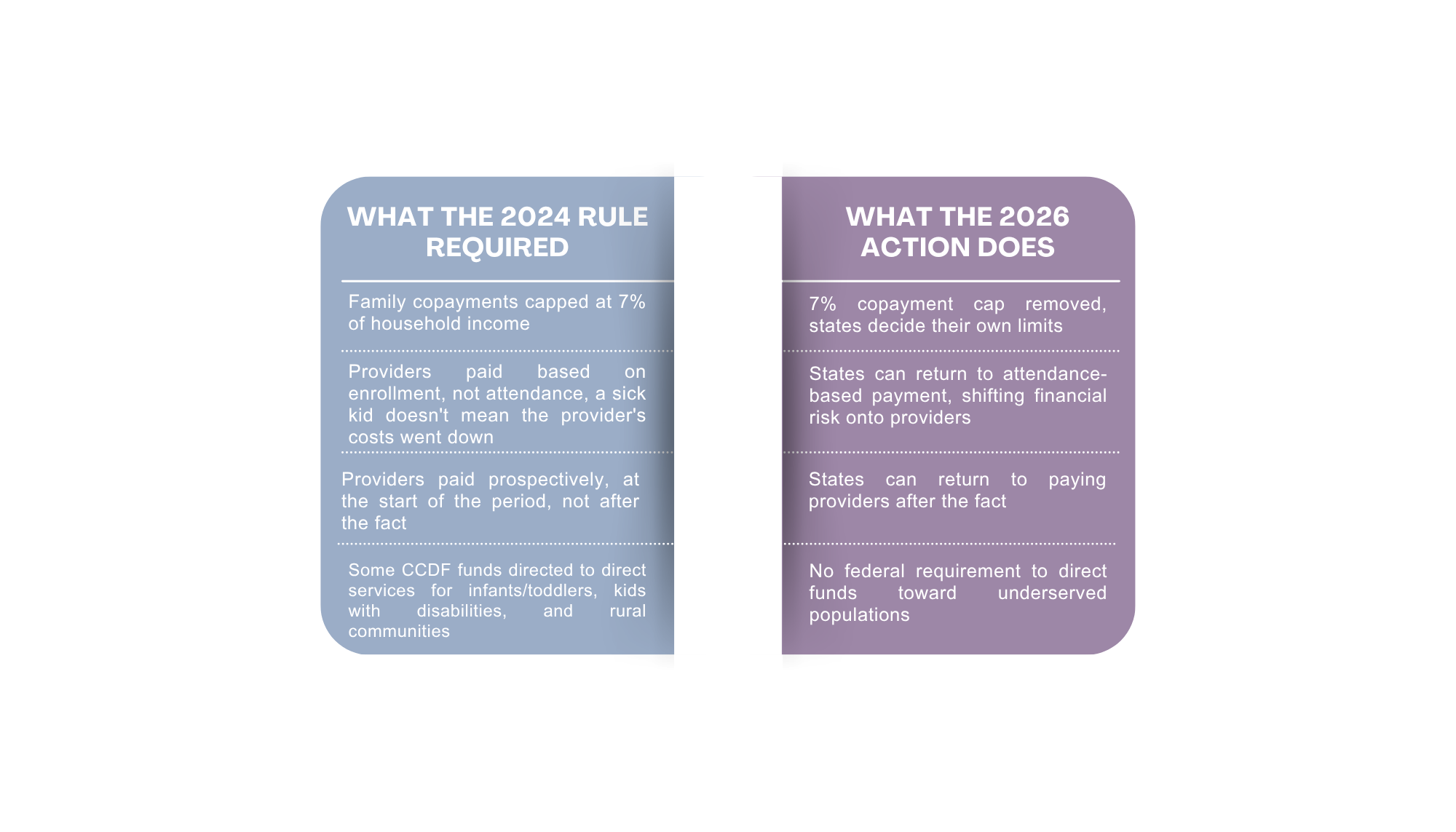
What this looks like for a real family
Consider a family of three in Ohio earning $6,455 a month, which is 300% of the federal poverty level and the upper limit of eligibility for Ohio's child care subsidy program.
The 2024 rule would have required Ohio to cap that at 7%, $452 a month, by a federal deadline. Ohio was one of 10 states that hadn't yet met that threshold as of 2025. The 2026 rule removed the requirement. Whether that family ever gets relief is now entirely up to Ohio.
If you're feeling like the floor just dropped out (again), you're right. The 2024 rule was imperfect, but it was a floor, a federal guarantee that no matter what state you lived in, child care costs couldn't consume an unlimited share of your paycheck. That guarantee is gone. What replaces it is variation: some states will protect families, some won't, and the families with the least leverage will feel it most.
What to watch and do
Find out where your state stands. Is your state one of the 10 that hadn't hit the 7% threshold? CLASP maintains state-by-state CCDF policy tracking, that's your starting point.
This just became a state-level fight. Advocates, watch your state legislature. Practitioners understand what your state's copayment schedule actually means for the families you serve.
Use this data. If you're making the case for child care affordability with funders, policymakers, or partners, the Ohio numbers are sourced, verified, and ready to use. [footnote: Ohio Dept. of Children and Youth, Publicly Funded Child Care Family Weekly Copayment Desk Aid, effective Oct. 1, 2024]
Both of these 2026 rules follow the same logic: they frame the 2024 federal floors as "overreach" devolving decisions to states and local programs under the banner of "flexibility' "parental freedom" and "cutting red tape." The practical result is that the people with the least leverage, low-income families and low-wage workers, lose vital protections, and geographic disparities will only widen.
To understand how this argument is being constructed, it's worth reading Assistant Secretary Alex Adams' recent press release and op-ed. Not because the framing is accurate, but because understanding the opposition's framework is essential to knowing how to respond. First Five Years Fund also has a useful breakdown of both rules.
This is a hard week to sit with. The early childhood field has spent years building the evidence base, making the case, and moving federal policy in the right direction, and watching those gains reversed is genuinely demoralizing. But the people in this field don't need to be told why this work matters. You already know. Keep going.
Data Spotlight
The numbers this month tell a story the field already knows in its bones, but they're worth naming out loud.
On May 11, the same day federal regulators moved to roll back child care protections, more than 3,850 educators and parents participated in Day Without Child Care 2026 across 30+ states and DC. The largest work stoppage in child care organizing history.
NAFCC's 2025–2026 Annual Survey finds that 35% of family child care educators earn less than $10 an hour, despite 71% working 50 or more hours per week.
The people holding the system together are doing it at a wage that doesn't hold them.
Eight years after their original report, CAP's 2026 child care desert analysis finds that just under half of all young children in the U.S. still live in areas without sufficient licensed care. The needle has barely moved in eight years.
The NIEER 2025 State Preschool Yearbook confirms that divergence between states is accelerating: where you live increasingly determines what you can access.
Eight years. The supply hasn't moved. The inequality has only deepened. And now costs have crossed a threshold that changes something more fundamental.
The New York Times and MS Now both report what practitioners are already hearing: child care costs are now factoring into whether young people have children at all. This is no longer just a family budget issue. It is a demographic one.
This is the throughline: supply hasn't moved in nearly a decade,costs have kept climbing, and the cumulative weight of that is now reshaping decisions about whether to have children at all. This is not a static inconvenience. It is a compounding policy failure, and it is now restructuring American family life from the inside out.
The Proof of Concept is Not Theoretical
RxKids: Direct Payments, Measurable Results In Flint, Michigan, a program called RxKids (founded by Dr. Mona Hanna and Professor Luke Shaefer) provides direct cash payments to expectant mothers and families with infants. The outcomes are documented: fewer evictions, healthier births, and improved parental mental health. Former U.S. Secretary of State Hillary Clinton highlighted RxKids in a recent (April 2026) New York Times op-ed, writing: "If we want to strengthen families, this is where we start, by helping parents stay afloat when a child arrives."
Minnesota Pay Equity Pilot: Stability Starts With the Educator In Minnesota, the Pay Equity Pilot provided direct funding to child care programs to raise educator wages. This is exactly the kind of state-level proof that federal PDG B-5 grants have been generating across the country, like Michigan's recent pre-K home provider pilot. Proposing to eliminate PDG B-5 in the FY2027 White House budget isn't just a line item. It is the defunding of evidence.
A Win Worth Naming
The Supporting Early-Childhood Educators' Deductions (SEED) Act passed the U.S. House of Representatives on April 27th, 2026, with unanimous bipartisan support. For the first time, the federal educator expense tax deduction would extend to early childhood educators, allowing them to deduct unreimbursed classroom expenses like books, supplies, and learning materials they purchase out of pocket.
This is a meaningful win, both symbolically and materially.
For too long, the tax code has drawn a quiet but consequential line: K–12 teachers could claim this deduction; pre-K and ECE educators could not, even though many spend hundreds of dollars of their own money each year on the same kinds of materials. The SEED Act corrects that. It acknowledges, in statute, that early childhood educators are educators, not a secondary workforce category. We'll take it.
The bill was led by Congressman Brian Fitzpatrick (R-PA) and Congressman Jimmy Panetta (D-CA) in the House, with a Senate companion measure championed by Senators Michael Bennet (D-CO) and Susan Collins (R-ME). It now awaits a Senate vote, passage would send it to the President's desk and complete a step that has been years in the making for a workforce long asked to do more with less.
Note: There are currently two bills called the "SEED Act" in the 119th Congress. The ECE-focused bill is H.R. 5334 / S. 2791. A separate S. 4408 addresses renewable fuel incentives and is unrelated.
State to watch: Illinois.
IDEC, the Illinois Department of Early Childhood, is scheduled to fully open July 1, 2026. A new Civic Federation report puts it plainly: Illinois took a historic step, but IDEC is not a magical fix. Significant uncertainty remains around structure, responsibilities, and implementation. Colorado, Massachusetts, New Mexico, and Oregon all built similar consolidated departments before Illinois, and that peer state experience is now informing what IDEC needs to get right. This is what system change actually looks like in the middle of it, messy, consequential, and worth watching closely.
What the Science Is Saying Right Now
A new research brief from Boston University, “How Does Early Childhood Education Impact Child, Family, and Community Health?” researchers in Current Opinion in Pediatrics reframes high-quality, affordable Early Childhood Education (ECE) as a critical public health intervention. Moving beyond simple school readiness, the evidence shows that ECE directly alters long-term life trajectories. It supports child development through stable routines and health screenings, reduces parental chronic stress by stabilizing employment, and boosts community economic vitality. Ultimately, the data proves that investing in early education is a foundational strategy for whole-community health equity
📌 What To Do With All Of It
Congressional pressure worked in February by a margin of just three votes. The FY2027 fight is officially underway, and the Head Start comment window closes June 11.
Here is where we take action:
🔗 Take Action: Submit a comment on the Head Start NPRM before June 11
💡 Get the Facts: Read the FFYF NPRM Explainer & check your State CCDBG Fact Sheet
🏛️ Call Congress: Urge your representatives to protect Head Start in the FY27 Budget
🗳️ Be Prepared: Find your state's primary election date
A Moment to Pause
May gave us two reasons to pause: Teacher Appreciation Week and Provider Appreciation Day. Together, they're a reminder that the people doing the most foundational work in a child's life are also among the most chronically underrecognized.
Early childhood educators show up with a consistency that most people never fully see, steady, skilled, present. Their work shapes how children learn to trust, to explore, and to belong. If you haven't reached out to someone in your network lately, consider this your nudge.
Gratitude does not have an expiration date.
A note from our team.
Last week, Early Childhood Solutions held its very first hybrid retreat, and it was time well spent. Some of our team made it to DC to meet in person for the very first time, while the rest joined virtually. We dug into the policy landscape, worked through team dynamics, and spent real time on our mission and vision.
The conversations were honest, the laughs were frequent, and we left more connected, to each other and to the work. Strong teams are built intentionally. This was one investment in that. We're grateful for every single person on this team. 🤎
The work is working. Not the federal budget. Not the political rhetoric. The actual work, the caregiver who shows up every morning, the program director who made the math work one more month, the advocate whose letter got the vote that protected the funding by three. That is evidence too.
We're in this with you.
— The ECS Team 🤎🤎🤎
