
ECS Exchange | April 2026
The Work Didn't Stop. Neither Did We.
We'll be honest with you: we missed a couple of months.
Not because the work stopped because it didn't. Not because the sector went quiet because it hasn't. But because sometimes the same exhaustion we write about catches up with us too. The early childhood field has been strained, and so has the broader state of our government. Both things are true, and both things are heavy.
So consider this our return from the field. We've been right there in the trenches with so many of you, watching funding fights play out in real time, tracking what's shifting at the state level, and trying to make sense of a policy environment that rarely slows down long enough to let anyone catch their breath.
April felt like the right moment to come back up for air together. There's momentum building right now. We see it in communities and coalitions, and especially in the stubborn insistence of practitioners who refuse to let chaos define their work. That's what this edition is about.
Here’s what we have been watching.
The Current Climate: A Year of Fortification Amidst Discord
In January, we said the ground was shifting beneath us. We weren't wrong, but we didn't have the full picture yet. The ground didn't just shift. It settled into something new. And somewhere along the way, the sector stopped calling it a crisis. That isn't because things got better, it’s because this level of instability became our norm.
The emergency did not end. It just stopped feeling like one.
This isn’t a transition anymore, it is simply the terrain we have to navigate. What felt like a crisis has quietly become the baseline, and the field has had to find its footing accordingly. Programs that were once asking “how do we grow?” are now asking “what can we protect, and for how long?” Leaders who were once planning for expansion are now making triage decisions about which staff to keep, which families to serve, which programs to fight for. We know the real pain that comes with not being able to help every family or grow in the way you envisioned, and the resilience of this community is the only reason we are still standing.
We are no longer in the era of emergency expansion. What has replaced it, is a period of deep systemic defense. Between global economic volatility and the erosion of federal pandemic-era support, the focus has moved from "what could be" to "what we must protect."
This kind of defense looks different from what we have practiced before. It isn’t the optimism of expansion, not ribbon cuttings and new classrooms and waiting lists finally shrinking. It's quieter, harder, and in many ways more demanding. It requires knowing your floor: which relationships, which funding streams, which community anchors are non-negotiable, then you build everything else around protecting them.
The "funding cliff" was never a single drop. It's a slow erosion that this field has been navigating in real time, with real stakes.
That isn’t defeat. That's discipline. And right now, discipline is what the moment requires.
Data Spotlight: The Numbers Behind the Noise
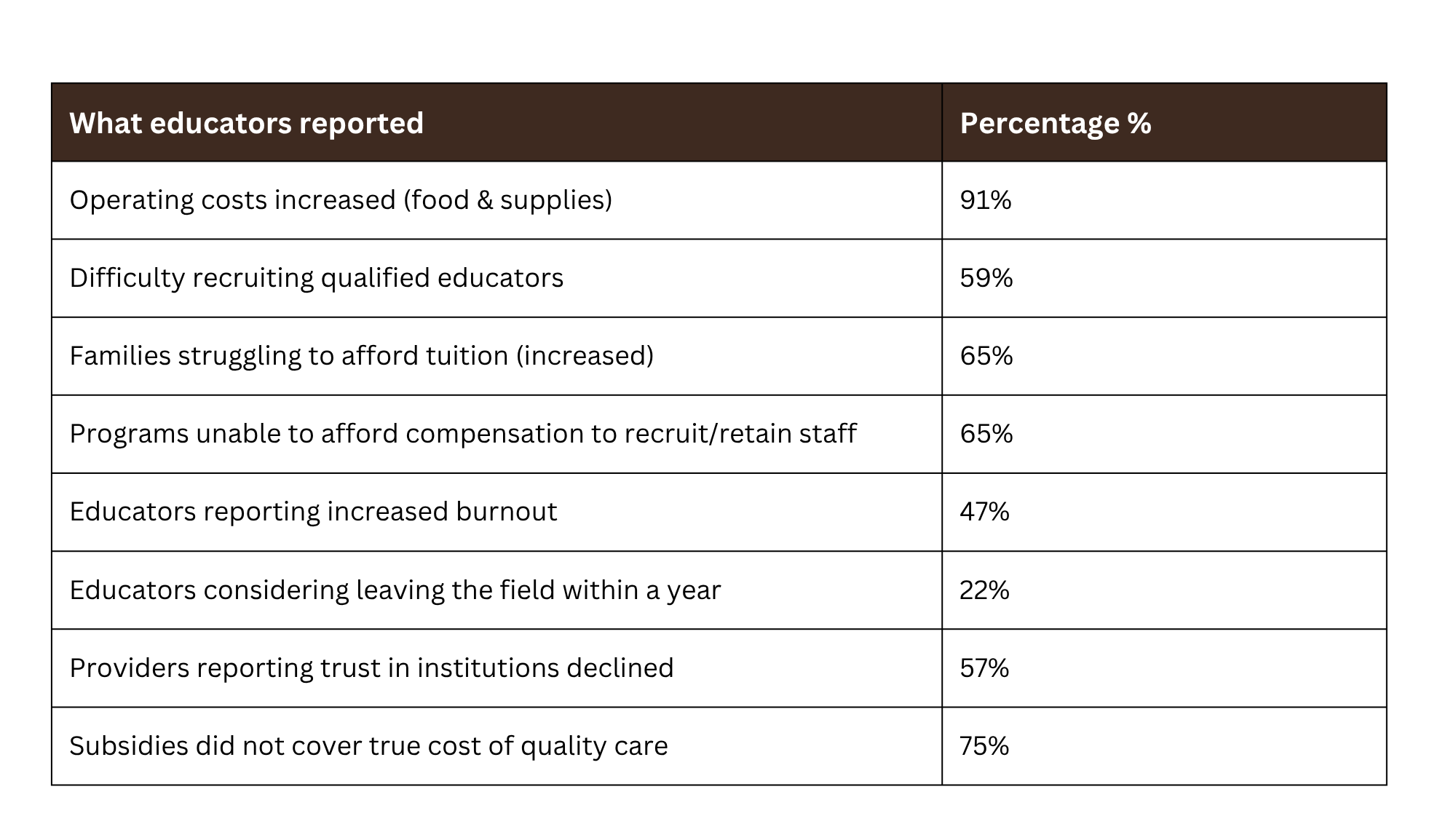
From the NAEYC 2026 workforce survey.
A field under strain:NAEYC's 2026 annual workforce survey found that the 2025 program year was among the hardest on record. Providers reporting widespread educator burnout, enrollment challenges, and a cost crisis hitting both sides of the equation. By the numbers, from NAEYC's 2026 workforce survey in the table to the right.
The $16B win: Congress recently passed the largest federal childcare investment in decades, giving more families access to bigger tax credits and allowing some working parents to claim up to half their child care costs. Congress passed a historic investment in child care while the administration is simultaneously proposing to cut and roll back the programs families depend on. The question is which one your representatives will continue to fight for.
A hard-fought partial win: On February 3rd, a funding package was signed that included $85 million increases for both Head Start and CCDBG. This was a meaningful moment for advocates who fought to keep these programs funded at all. But the increases still fall roughly $160 million short of matching inflation.
An April gut punch: The FY2027 White House budget, released on April 3rd, proposed level funding for CCDBG ($8.8B) and Head Start ($12.3B) while eliminating the Preschool Development Block Grant Birth Through Five (PDG B-5) entirely. Level funding, as we've established, is a cut in real terms.
States filling gaps — and creating new ones: New York, Vermont, and Washington are moving more dollars into the sector. Meanwhile, Indiana and Arkansas have cut reimbursement rates for providers serving subsidy families, and several states have raised copays for families already enrolled in assistance programs. The divergence is accelerating.
The bottom line: The headline numbers don't tell the full story. A win in February, a cut in April, a workforce burning out in between is the actual landscape of 2026.
A partial win is still a win.

As the data shows, the funding package signed on February 3rd, included $85 million increases for both Head Start and CCDBG. This was a hard-fought win for advocates, even if it still falls about $160 million short of keeping up with inflation.
Let's talk about what this means:
The original administration budget proposed eliminating the Preschool Development Grant Birth through Five (PDG B-5) and Child Care Access Means Parents in School Program (CCAMPIS) entirely. Congress pushed back and passed the increases by the narrowest of margins: 217 to 214. This win reiterates the importance of having representatives that support our field.
$8.831 billion for CCDBG: an increase of $85 million
$12.357 billion for Head Start: an increase of $85 million
$315 million for Preschool Development Grants Birth through Five (PDG B-5)
Let's talk about April’s Gut Punch
It is hard to come up for air. On April 3rd, the FY2027 White House budget proposed to level funding for CCDBG and Head Start, and eliminate the Preschool Development Grant entirely. We've already established what level funding actually means when costs keep rising: it's a cut dressed up as a hold. Congress pushed back last year.
The question is whether they will again, and that answer depends, in part, on who's sitting in those seats come November.
Congress holds the power to set federal funding levels for the programs this field runs on Head Start, CCDBG, PDG B-5. When those levels fall short, it's a classroom that can't hire a second teacher. It's a family that waits another year on a list that never seems to shrink.
Dr. Ruth Friedman, a respected colleague of ECS, recently broke down how the Trump administration is making life more difficult for child care providers and parents. Here are a few important points we want to highlight:
The core threat: The administration is moving to roll back two hard-won 2024 CCDF reforms: enrollment-based payment and prospective, upfront payment to providers. These aren't loopholes. They're standard business practice across every other sector of education, from Head Start to public K–12. Rolling them back shifts costs directly onto providers who are already operating on margins that leave no room for error.
The fraud framing is manufactured: The administration has characterized these payment practices as fraudulent. That claim is not accurate. Calling standard business practices “fraud” is more of a rhetorical strategy than a policy argument., Our ability to push back on it starts with recognizing it for what it is.
The chilling effect is already here: Ohio had already passed legislation to comply with the 2024 reforms but they reversed course as soon the rollback was announced. Washington state is moving in the same direction. Even though the rule isn't final yet, it's already unwinding progress that took years to build.
What Can We Do?
This is a midterm election year, which means the composition of Congress is on the ballot. Who sits in those seats shapes what's possible for the families we serve, which programs get protected, and which ones get traded away in a budget negotiation.
It is hard to be in this field when the president has publicly dismissed it. When asked about federal support for child care, he said: "We're fighting wars. We can't take care of day care." But what this field does is not just “day care” in the diminished way that framing implies. It is workforce infrastructure, economic mobility, and brain development and the families we serve know that better than anyone.
Congressional pushback is already happening: as of late March, Democratic Senators submitted a Dear Colleague letter in support of federal funding for child care and early learning. A clear signal that the FY2027 fight is underway and that advocacy pressure is moving.
Your voice can be part of that. And this year, so can your vote.
Want to see what's happening with child care funding in your state specifically? The First Five Years Fund has a real-time state impact tracker worth bookmarking.
Resources to stay current:
🔗 FFYF Appropriations Tracker: updated in real time as budget decisions move
🔗 CLASP CCDBG Fact Sheet: the most precise breakdown of what the $85M increase actually means
🔗 Bipartisan Policy Center: research and policy analysis on early childhood from across the political spectrum
Take civic action, by contacting Congress:
🔗 Urge Congress to Protect Head Start in the FY27 Federal Budget
🔗 Tell Congress to Support the Child Care for Working Families Act
🔗 Tell Congress: It’s time to invest in child care and families
🔗 Email Congress: Protect and prioritize Funding for Early Learning and Care Programs
Make sure to vote in the Midterm Elections
State-Level Leadership in Action
The federal picture is what it is, and some state leaders have decided not to wait for it to improve.
New Mexico: What began as a program is now a law. During this session, New Mexico codified universal child care into state statute. This cements its constitutional permanent fund investment against federal volatility and signaling that this is not a pilot or a promise. It's infrastructure.
Illinois (IDEC): The launch of the Illinois Department of Early Childhood represents a major structural victory, consolidating authority to reduce the bureaucratic burden on families who are already overstretched. System change is slow and this is what it looks like when it actually happens.
California: State-funded preschool enrollment reached 1.8 million children last school year which is the highest ever. California alone accounted for more than half the gains after making every 4-year-old eligible for its transitional kindergarten program. Access varies dramatically from state to state, with some states losing their ground.
The Political Horizon: Early care and education is proving to be a viable campaign issue. Candidates who ran on child care, ran on helping families and children, won. New York, Vermont, and Washington are all moving more dollars into the sector. While the federal story is one of stagnation, the state story is one of momentum. It is uneven, fragile, but it is real.
Research Spotlight: Stability as a Biological Necessity
In a climate defined by high stress, the newest research from the Harvard Center on the Developing Child underscores its urgency. Their latest briefing argued that environmental stability, specifically the consistency of caregiver relationships, is a biologicalrequirement for healthy brain development.
The Center's resilience scale concept makes this concrete — when stable, responsive relationships are present, they literally tip the biological scale toward positive outcomes, buffering the effects of adversity.
This research provides sobering justification for the current policy focus. We aren't just fighting for better "school readiness. We are fighting to give children a consistent human buffer against an increasingly unstable world. That's the mandate. And the system meant to deliver that buffer is being asked to do more with less, year after year, without end in sight.
How to use this research right now:
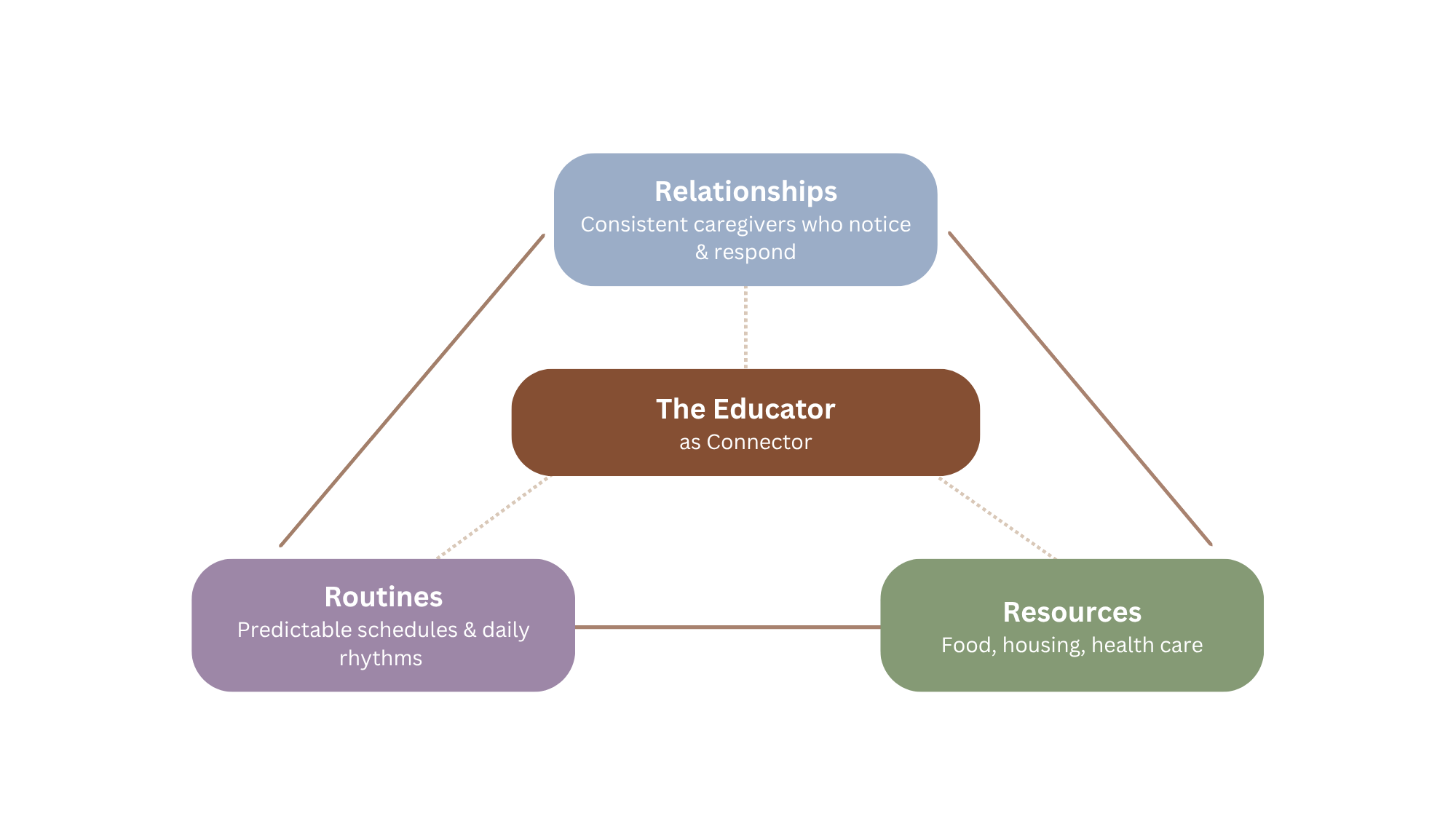
The research tells us what's at stake. The question isn’t whether this work matters, it's how we protect it. The Urban Institute's framework puts it plainly: children need stability across relationships, basic resources, and daily routine. If you pull on any one strand,the others weaken too. That means this work was never siloed. Now we have the research to prove it.
Treat stability as the outcome, not the prerequisite. Your work is the stability intervention. The consistent teacher, the reliable pickup time, the caregiver who notices when something's off are all doing the work of building brain architecture. Name it that way. Research on Positive Childhood Experiences (PCEs) shows they directly counterbalance ACEs — and ECE programs are documented PCE deliverers. Your program isn't just preventing harm. It's actively building the conditions for resilience.
Map your web, then make it visible. Employers, health care providers, civic organizations, housing authorities are all part of a child's stability web, whether they know it or not. Think back to the translation work we discussed in January, who else benefits from your work existing, and are you speaking their language?
Stabilize the stabilizers. If educators are financially unstable and leaving the field, children feel it. Workforce stability isn't an HR issue. It's a child development issue. Advocating for educators is advocating for children. Full stop. NAEYC's Power to the Profession framework makes the case plainly: well-prepared, well-compensated educators are not a workforce perk — they are the infrastructure.
You didn't sign up to be a stability intervention. But here you are, doing exactly that. With less money, more uncertainty, and higher stakes than ever.
Professional Engagements
Navigating this year requires both rigorous data and community-honoring design. Here are two upcoming conferences:
NRCEC 2026 (June 22–24, Arlington, VA): Expect a deep focus on the Head Start enrollment declines and the impact of the funding freeze.
NAFCC Annual Conference (July 16–18, Chicago): A vital convening for home-based providers, who often bear the heaviest load of systemic neglect.
ZERO TO THREE LEARN Conference 2026 (October 27-29, Portland, OR): A cross-sector convening for educators, mental health leaders, researchers, and advocates — one of the few spaces where infant-toddler policy and practice sit at the same table.
Essential Reading for Equity and Resilience:
"Meet Me at the Library" by Shamichael Hallman: An exploration of libraries as last-resort infrastructure for social cohesion.
"The Equitably Resilient City" by Zachary Lamb: A necessary look at how city design can either shield families from, or expose them to, the effects of global instability amidst a climate crisis.
Mental Health Resources for Educators and Leaders
Resources for Supporting the Mental Health of Early Childhood Educators: dedicated hub of mental health resources, articles, and support tailored specifically to the behavioral health needs of early childhood educators.
NIH Resources for Students and Educators: learning resources, videos, and activities covering mental health and brain health for educators who want to support their classrooms and take care of themselves in the process.
Active Minds Self Care: practical self-care guidance and mental health resources to help anyone maintain their wellbeing and support their own recovery when they need it.
NIH Caring For Your Mental Health: practical guidance on mental health as emotional, psychological, and social wellbeing, with self-care tools to help anyone sustain their health and quality of life.
Join the ECS Member Portal — It's Free
The work we cover in this newsletter doesn't stop between editions, and neither does ours. The ECS Member Portal is where we share resources, updates, and tools in real time, so you're never waiting on the next newsletter to get what you need. It's free, it takes two minutes to join, and it's built for the people doing the work you're doing.
The Through-Line: What This Edition Is Really Saying
Every section of our newsletter is describing the same moment field that has stopped waiting for conditions to improve and started building for the conditions that exist.
The data shows that the federal picture is strained and the inflation gap is real. The state section shows that some leaders have decided not to wait for Washington. The research tells us that stability isn't a nice-to-have,it's a biological necessity that we are actively providing. The advocacy section explores how Congress is the variable, and this year our vote is part of that equation.
It's all pointing to the same thing: the work is harder than it was, the stakes are higher than they were, and the people doing it are still showing up anyway. That's not just resilience. That's a professional commitment to children that this political moment has not managed to break.
You're writing grants at 11pm because the deadline won't move and the need won't wait. You're explaining to families why their subsidy got cut while fighting to make sure it doesn't happen again. You're stabilizing children while navigating your own instability. That's the work. And it matters more than the people setting the budget seem to understand.
One More Thing
One way we have been centering ourselves as a team in the middle of all of this is by returning to our mission. It sounds simple ,maybe even obvious, but it is so easy to lose the thread when the policy environment is this loud and this heavy.
Our mission is our compass.
It doesn't tell you which grant to write first or how to navigate the CCDF rollback. But it does remind you why you're in the room at all (or in our case, meeting virtually). In a year that is asking so much of everyone in this field, that clarity is huge. It's the difference between burning out and burning forward.
We're not going to pretend the work is easy. But we do believe the work is worth it. And we believe the people doing it ~ you ~ are exactly who this moment needs.
We are in this with you.
—The ECS Team 🤎🤎🤎
